
To What Extent do Citizens Around the World Support the Liberal Idea of Non-Discrimination in Access to the Labor Market?
SCRIPTS Blog Post No. 81 by Jürgen Gerhards and Johannes Giesecke
Dec 16, 2025

SCRIPTS Blog Post no.81
Image Credit: Pixabay/ Ohmydearlife
The idea that all people are equal and no one should be discriminated against is a key component of liberal thought. In regard to access to the labor market the notion of non-discrimination means that jobs should be awarded on applicants’ qualification and not on the basis of their gender, ethnicity, religion or family background. A substantial number of international treaties and regulations, including the European Union’s anti-discrimination directives, have been established to make the prohibition of favouritism based on group membership a global norm. However, reality shows that women, ethnic and religious groups are still often discriminated against in the labor market.
Until now we know very little about the extent to which citizens across the globe support the idea that applicants' qualifications and not ascriptive characteristics should determine their opportunity to become employed. Drawing on a novel public opinion survey named “Public Attitudes towards the Liberal Script” (PALS), we examined the extent to which citizens across the world support the idea that job recruitment should be based solely on applicants’ qualifications and not on ascriptive characteristics such as gender, family background, ethnicity, or religion1. PALS collected data from 26 countries and roughly 60,000 respondents. The data are representative of each country’s population and include countries from all world regions. The data are freely available. Furthermore, there is the PALS Data Navigator, designed to help users explore for themselves what people around the world think about liberal principles and institutions.
To find out whether respondents support the liberal notion of non-discrimination, we considered four different ascriptive characteristics: gender, family background, ethnicity, and religion. To measure the four dimensions respondents were asked the following questions: “To what extent would you agree or disagree to each of the following statements?” When jobs are scarce, (1) men should be preferred over women, (2) family members and friends should be preferred over others, (3) people who belong to the same ethnic group as me should be preferred over others (4) people who have the same religion as me should be preferred over others.
In a first step, we analyzed whether citizens' attitudes toward job selection based on the four characteristics are related and constitute are more generalized pattern of non-discrimination attitudes. This is indeed the case, as people either believe that qualifications should be the primary criterion for job selection or qualifications should be outweighed by ascriptive characteristics. Given that the answers to the four questions are strongly correlated and form a single dimension, we constructed an index (factor scores), summarizing all four questions. Higher scores on this construct of non-discrimination reflect more liberal attitudes.
Figure Mean values of 26 countries regarding citizens' attitudes towards non-discrimination
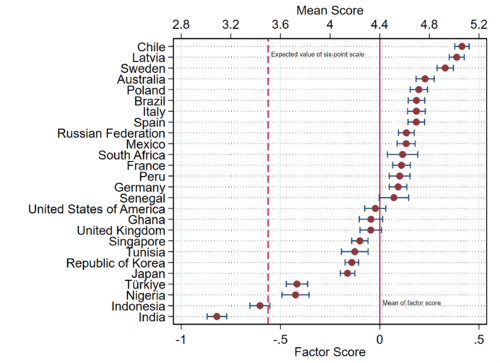
The mean value across all countries indicates a strong endorsement of non-discriminatory attitudes. Furthermore, support for non-discrimination in the labor market significantly outweighs opposition, as in 22 of the 26 countries, the average values reflect medium to high levels of support for non-discrimination, with scores exceeding 4 on the original six-point scale. This result indicates a surprisingly strong support for the liberal idea of non-discrimination in the labor market in many of the surveyed countries.
At the same time, we find substantial variations between countries. Citizens in Chile, Latvia and Sweden are on average the most supportive of the idea of non-discrimination. At the other end of the spectrum, we find countries as Nigeria, Türkiye, Indonesia and India, in particular, with low levels of support. Finally, some of the countries’ values somewhat contradict our everyday understanding. The US and UK, for example, are among the oldest liberal societies; at the same time, however, support for the principle of non-discrimination in both countries is slightly below the mean and comparable to the average levels of support found in countries such as Ghana or Tunisia.
In order to better understand these variations in citizens' attitudes, both theoretically and empirically, we referred to two broader sociological theories: world society theory and modernization theory. As it is not easy to explain both theories and how we implemented them empirically in a short blog post, we refer to the paper cited in the footnote. World society theory expects that respondents from countries more deeply embedded in world society, as well as individuals who support the globally institutionalized norms and have attained higher levels of education, are more likely to endorse the principle of non-discrimination. In contrast, modernization theory expects that the more modernized a country is, the better the respondents' economic situation, the more educated and secularized individuals are, and the more they have internalized post-material values, the greater their likelihood of supporting non-discrimination in labor market access.
Results from multivariate analysis demonstrate that both modernization theory as well as world society theory contribute to explaining citizens' attitudes toward non-discrimination. With regard to world society theory, findings show that citizens living in countries embedded in world society are more likely to support the principle of non-discrimination. On the individual level, it turns out that peoples’ general commitment to the norms of a global culture and their level of education are associated with support for non-discrimination. In regard to characteristics derived from modernization theory, we find that a country’s level of modernization does not directly impact on non-discrimination attitudes, but many of the individual features derived from modernization theory do, as more educated and secularized individuals and those holding post-material values are more likely to support the non-discrimination norm. However, one has to take into consideration that a country's composition with individuals having these characteristics can at least partially be seen as the result of macro processes. For example, the fact that there are significantly fewer highly educated people in India compared to Latvia is the result of different historical developments related to modernization processes.
Overall, however, we can conclude that while many liberal ideas are highly controversial at present, this is not the case for the notion of non-discrimination.
1 Gerhards, Jürgen & Johannes Giesecke. 2024. Non-Discrimination in Access to the Labour Market and its Support by Citizens in 26 Countries around the World. SCRIPTS Working Paper No. 51, Berlin: Cluster of Excellence 2055 “Contestations of the Liberal Script (SCRIPTS)”. https://www.scripts-berlin.eu/publications/working-paper-series/Working-Paper-51-2024/SCRIPTS_Working_Paper_51_WEB.pdf